

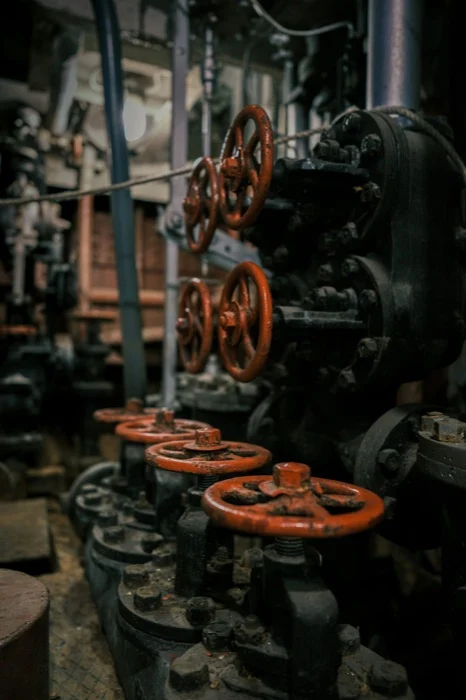
A gate valve and a butterfly valve both do the same job on a distribution main: close a line so a section can be worked on, then open it again, ideally for decades, ideally drip-tight. They reach it in different ways, and the choice is rarely about preference — it is about diameter, headloss and what the chamber can hold. Specify the wrong one and you either pay for a valve far larger than the duty needs, or you fit one that steals pressure from the network every day it sits open.
How each one seals
A gate valve drives a wedge or a rubber-faced gate down across the full bore. When it is open, the bore is clear and the water runs straight through; when it is closed, the gate seats on both faces. A modern resilient-seated gate valve to EN 1074-2 seals on a rubber-encapsulated wedge and needs no bottom recess to collect grit, which is why it has replaced the old metal-seated double-gate on water networks.
A butterfly valve turns a disc on a shaft through ninety degrees. Open, the disc sits edge-on in the flow but still occupies the centre of the bore; closed, its rim seats against a liner around the body. A quarter turn takes it fully shut, so it actuates quickly and compactly — but the disc never fully leaves the waterway.
Where the gate valve earns its place
On smaller mains — up to around DN 300, and routinely to DN 400 — the gate valve is the default. The clear bore means almost no headloss when open, so a line full of gate valves does not quietly tax the pumps. It seats drip-tight at low cost, buries neatly under a surface box with a spindle extension, and tolerates the grit and debris of a working network. For a branch, a hydrant lead, or a section valve on a street main, it is hard to beat.
Its limit is size and weight. As the diameter climbs, a gate valve grows tall — the gate has to withdraw clear of the bore — and heavy, and both the valve and the chamber to house it get expensive fast.
Where the butterfly valve earns its place
Above about DN 300, the economics invert. A butterfly valve is shorter face-to-face, far lighter, and cheaper to make at large diameters, and it fits a shallower chamber because it does not need headroom for a rising gate. On transmission mains, pump-station headers and large trunk connections, it is usually the right answer, almost always fitted with a gearbox or actuator because the disc sees real torque under flow.
The trade-off is the disc in the bore. It adds a small permanent headloss and it collects rag and debris, so it suits clean transmission duty better than a debris-heavy low-level main. It is also not the valve to throttle with on most water duties — part-open, the disc wears and the flow is unstable — so treat it, like the gate valve, as an on/off isolator.
| Factor | Gate valve | Butterfly valve |
|---|---|---|
| Typical size | DN 50–400 | DN 300 and above |
| Headloss open | Negligible (full bore) | Small but permanent (disc in bore) |
| Chamber | Taller, heavier | Compact, shallower |
| Cost at large DN | Rises steeply | Lower |
| Best duty | Street mains, branches, hydrant leads | Trunk mains, pump headers |
Actuation and the chamber
Both valves bury, but they ask different things of the chamber. A buried gate valve takes a cap, a spindle extension to the surface, and a surface box at road level — simple, and operable from the carriageway with a tee key. A large butterfly valve usually carries a gearbox and handwheel or an actuator, which wants room and access, so the chamber is designed around the gearbox, not just the valve body.
Whichever you choose, fit a dismantling joint beside it. It takes up the flange tolerance, lets the valve come out without springing the pipework, and turns a half-day excavation into a bolt-up job the next time the valve needs service.
Materials and coating
Whichever valve you specify, most of its life is a fight against corrosion, so specify the protection, not just the body. Both types are usually ductile iron to EN 1563, protected inside and out by fusion-bonded epoxy to EN 14901 — name a minimum coating thickness, commonly 250 µm, because it is the coating, not the iron, that meets the ground. Seats and seals are EPDM where the duty is potable water; confirm the elastomer is approved for drinking-water contact. And protect the bolting: stainless or coated bolts in a buried chamber, because ordinary bolts rust through long before the valve body does and turn a routine valve change into a cutting job.
Proving the valve
A new valve should arrive tested to EN 1074 — shell and seat proven at the factory — and it should be proved again in the chamber before backfill: open and close it under pressure, confirm it seals, and record it. A valve buried untested is a valve you discover is seized on the day you need it most, with the main charged and a burst waiting downstream.
What to write in the BOQ
Name the type, the standard, the diameter, the pressure rating and the end connection: “Resilient-seated gate valve, EN 1074-2, DN 150, PN 16, flanged to EN 1092-2, with surface box and spindle extension,” or “Double-flanged butterfly valve, DN 600, PN 16, with gearbox.” Add the dismantling joint on the same line. State whether the duty is isolation only — on both valve types it should be — so no one later tries to throttle with a valve built to sit open or shut.

GON supplies drainage, water, gas and road-infrastructure products to contractors, utilities and IFI-funded programmes across Georgia.